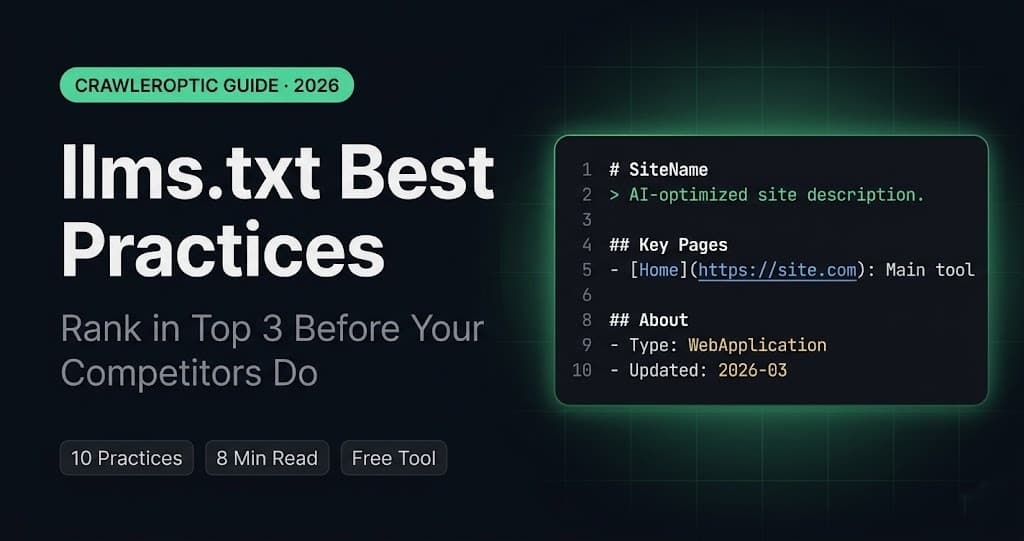
What is GEO? The Complete Guide to Generative Engine Optimization in 2026
GEO (Generative Engine Optimization) is the new discipline of optimizing your content to be cited in AI-generated answers from ChatGPT, Gemini, and Claude. Here's everything you need to know.
SEO Is No Longer Enough
For 30 years, ranking on Google's first page was the ultimate goal of digital marketing. Get to position one, get the clicks, grow your business. Simple.
That model is breaking down fast.
In 2026, over 45% of Americans use AI tools weekly for research. When someone asks ChatGPT "what's the best llms.txt generator?" or asks Gemini "how do I optimize my site for AI crawlers?", they're not clicking ten blue links. They're reading a synthesized answer — and that answer cites specific sources.
If you're not one of those sources, you don't exist for that user.
This is why Generative Engine Optimization (GEO) has emerged as the most important new discipline in digital marketing. And if you're reading this in 2026, you're still early.
Start your GEO journey today: use the free llms.txt generator at CrawlerOptic to make your site AI-citation-ready in 30 seconds.
What is Generative Engine Optimization (GEO)?
Generative Engine Optimization (GEO) is the practice of optimizing your website and content to earn citations in AI-generated answers.
Traditional SEO targets ranking algorithms — PageRank, relevance signals, backlinks.
GEO targets citation algorithms — the systems that decide which sources AI models reference when synthesizing answers.
The goal shifts from "rank #1 on Google" to "be cited by ChatGPT, Gemini, Claude, and Perplexity when users ask questions in your space."
Why GEO Is Different from SEO
| Traditional SEO | Generative Engine Optimization (GEO) |
|---|---|
| Targets Google's ranking algorithm | Targets AI citation systems |
| Success metric: SERP position | Success metric: Citation frequency |
| Optimizes for keywords | Optimizes for question-answer relevance |
| Link building = authority | Unlinked brand mentions also build authority |
| JavaScript content can rank | JavaScript content is invisible to AI |
| Meta tags matter | Structured data (JSON-LD) matters more |
| Takes 3-6 months to see results | Early movers compound advantage faster |
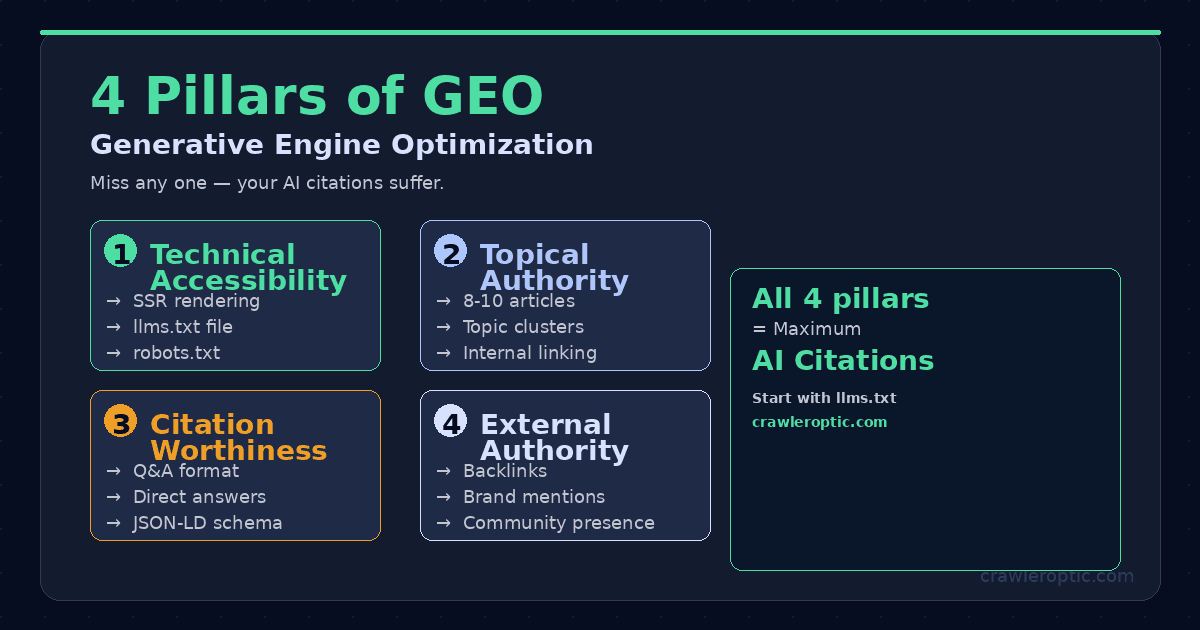
The Four Pillars of GEO
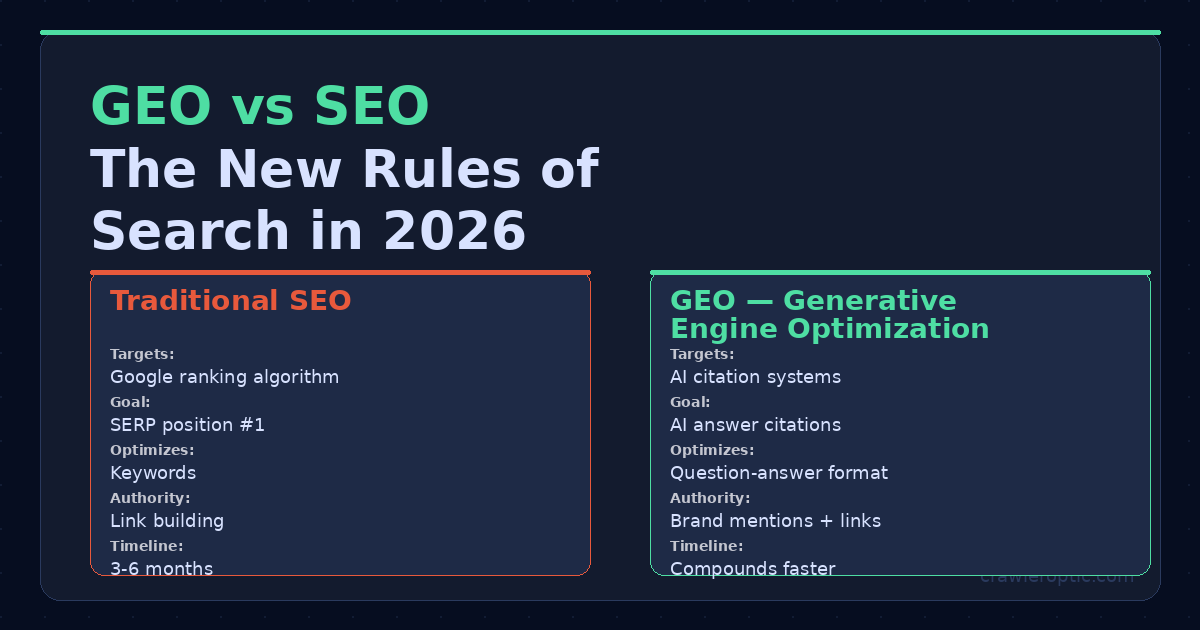 Traditional SEO targets Google's ranking algorithm. GEO targets AI citation systems. In 2026, you need both.
Successful GEO in 2026 rests on four interconnected pillars. Miss any one of them and your citations will underperform.
Pillar 1: Technical AI Accessibility
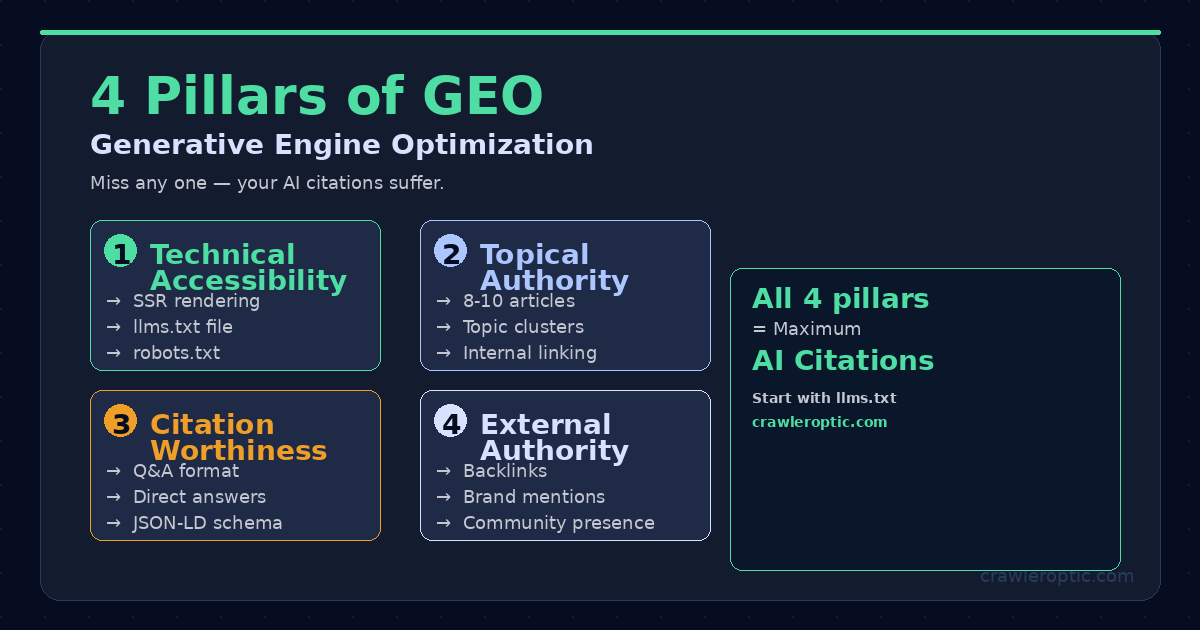 All four pillars of GEO must work together. A weakness in any one pillar limits your AI citation potential.
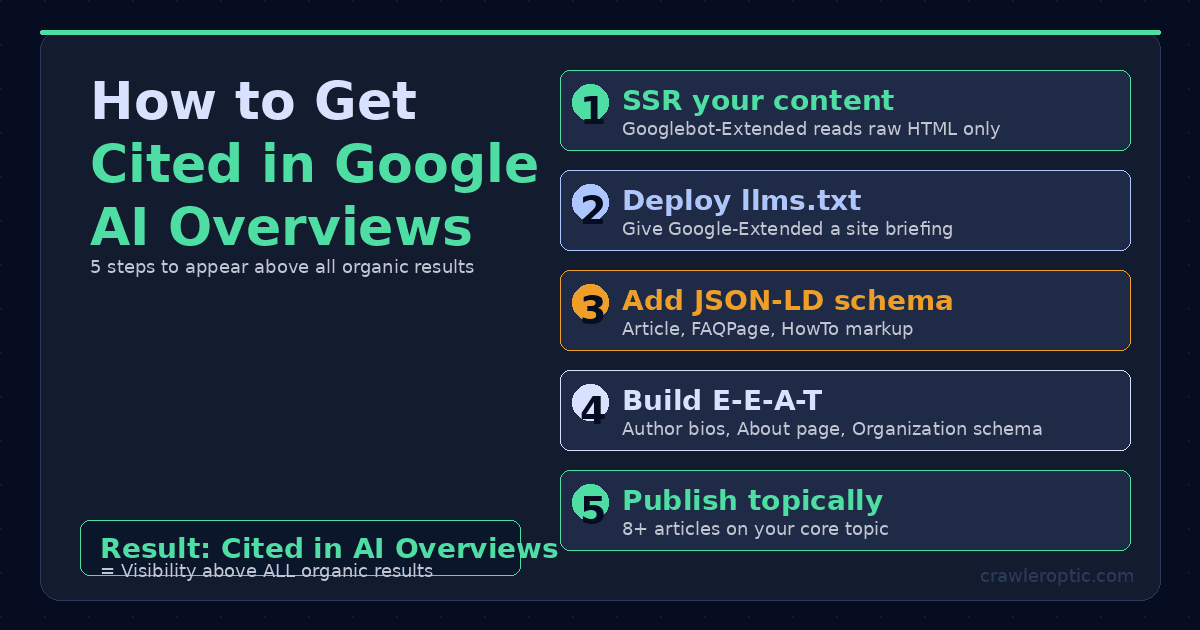
AI crawlers read raw HTML. They do not execute JavaScript. This single fact changes everything about how you should build and structure your website in 2026.
What you must do:
- Ensure all key content — especially headings, body text, and key facts — is present in the server-rendered HTML
- Use server-side rendering (SSR) for your most important pages
- Verify your robots.txt allows GPTBot, ClaudeBot, and Google-Extended
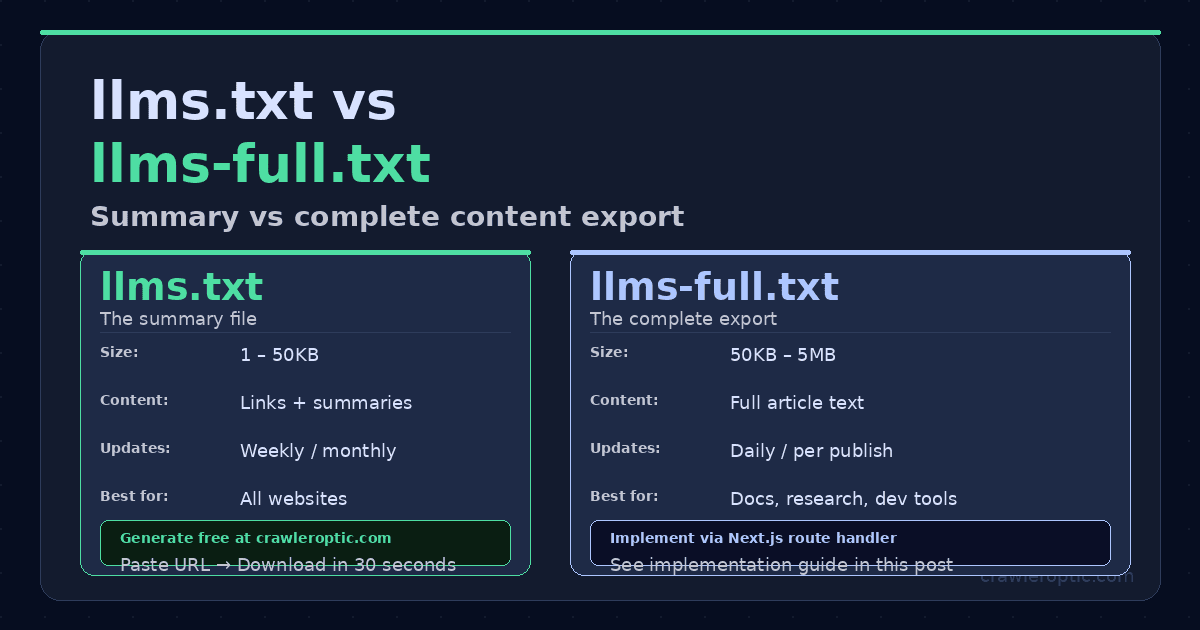
- Create a
llms.txtfile at your domain root — this gives AI systems a structured briefing about your site (generate yours free here) - Add comprehensive JSON-LD schema markup to every page
Quick technical check: Run curl https://yourdomain.com | grep "h1" in your terminal. If you don't see your H1 heading in the output, AI crawlers can't read it.
Pillar 2: Topical Authority
AI systems don't cite random pages — they cite sources they've identified as authoritative on a topic. Building topical authority requires consistent, comprehensive coverage of your subject area.
What you must do:
- Publish at minimum 8-10 articles on your core topic before expecting significant AI citations
- Cover your topic from multiple angles — beginner guides, technical deep-dives, comparisons, case studies
- Use a topic cluster structure: one pillar page (comprehensive overview) supported by multiple supporting articles
- Internally link all related articles to reinforce topical signals
- Answer the specific questions your target audience asks AI tools
The research method: Open ChatGPT or Claude in incognito mode. Start typing questions about your topic and observe the autocomplete suggestions. These are the exact questions millions of people ask AI tools — they're your content brief.
Pillar 3: Citation Worthiness
Even if your site is technically accessible and topically authoritative, your content must be formatted in a way that's easy for AI systems to extract and cite.
What you must do:
- Structure content around direct questions and clear answers
- Use H2 headings as questions ("How does X work?" "What is Y?")
- Lead each section with a direct, citable answer in the first 1-2 sentences
- Include specific data points, statistics, and verifiable facts — AI systems prioritize citable specifics
- Write in clear, authoritative prose — not promotional language
- Keep paragraphs short and focused (3-4 sentences maximum)
The citation test: Read any section of your content aloud as if you were an AI answering a user's question. Does it sound like a natural, authoritative answer? If it sounds like a sales pitch, rewrite it.
Pillar 4: External Authority Signals
AI models learn about your brand from the entire web, not just your own site. Every mention of your brand on a third-party website reinforces the model's understanding of who you are and what you do.
What you must do:
- Earn backlinks from relevant, authoritative websites in your space
- Get mentioned in industry newsletters, podcast show notes, and community discussions
- Submit your tool to directories and comparison sites relevant to your category
- Create content that other sites naturally want to link to (original research, unique tools, definitive guides)
- Build a presence on platforms where your audience discusses your topic (Reddit, LinkedIn, Twitter/X, Hacker News)
Important: Unlinked brand mentions count. When a Reddit thread mentions your brand name without linking to you, AI models still pick up that signal. Quantity and quality of third-party mentions both matter.
GEO vs SEO: Should You Choose?
No. They're complementary, not competing.
Strong traditional SEO — quality content, technical health, backlinks — is actually the foundation of strong GEO. AI tools that perform live web search (like ChatGPT's web search feature) pull from the same ranking signals as Google. A site that ranks well on Google tends to get cited more by AI tools.
The difference is that GEO requires additional optimizations that traditional SEO doesn't:
- Server-side rendering for AI crawler accessibility
llms.txtfor structured AI briefing- Question-answer content format
- JSON-LD schema for machine-readable context
Think of it this way: SEO gets you found by search engines. GEO gets you cited by AI systems. In 2026, you need both.
Real GEO Results: What to Expect
GEO is not an overnight strategy. Here's a realistic timeline:
Month 1: Technical foundation — SSR, llms.txt, schema markup, robots.txt audit. These changes are immediate and start signaling to AI crawlers from day one.
Months 2-3: Content depth — publishing 8-10 high-quality articles. AI systems begin recognizing your domain as topically relevant.
Months 3-6: Citation emergence — your content starts appearing in AI-generated answers for long-tail queries. Traffic from AI referrals begins showing up in analytics.
Months 6-12: Authority compounding — as more AI systems cite you, your brand gains broader recognition. Citations beget citations.
Research suggests that brands cited by LLMs see 40-65% traffic increases within six months of implementing a comprehensive GEO strategy.
Your GEO Starter Checklist
Use this checklist to audit your current GEO readiness:
Technical (do today):
- Key content is in SSR HTML (test with
curl yourdomain.com) - robots.txt allows GPTBot, ClaudeBot, Google-Extended
-
llms.txtfile is live at your domain root (generate free) - JSON-LD schema markup on all key pages
- Canonical tags set correctly
Content (this week):
- At least 5 articles published on your core topic
- H2 headings framed as questions
- Direct, citable answers in first paragraph of each section
- Internal linking between related articles
- No promotional language in factual sections
Authority (this month):
- Submitted to relevant industry directories
- Active presence in 2-3 relevant online communities
- At least 3 backlinks from domain authority 40+ sites
- Brand mentioned on third-party platforms
Start Your GEO Strategy Today
The brands winning in AI-powered search in 2026 aren't the biggest or oldest — they're the ones who started optimizing for AI citations earliest.
Begin with the technical foundation: generate your llms.txt file for free at CrawlerOptic, verify your robots.txt isn't blocking AI crawlers, and make sure your content is server-side rendered. These three steps alone will put you ahead of the majority of websites in your space.
The AI search era is here. The question is whether you're optimizing for it.
Generate your free llms.txt at CrawlerOptic — the first step in your GEO strategy.