How Google Gemini Crawls and Indexes Your Website in 2026
Google operates two separate crawlers — one for Search, one for Gemini AI. Most websites are optimized for the first and invisible to the second. Here's how to fix that.
Google Has Two Crawlers — Most Sites Only Optimize for One
When people talk about "Google SEO," they mean optimizing for Googlebot — the crawler that builds Google Search's index. This is traditional SEO: keywords, backlinks, Core Web Vitals, E-E-A-T.
But in 2026, Google operates a second, separate crawler specifically for its AI products: Google-Extended.
Google-Extended feeds data to Gemini (Google's AI assistant), Google AI Overviews (the AI-generated summaries at the top of search results), and Google's broader AI research systems.
These are different products with different citation patterns. A page that ranks #1 on Google Search can simultaneously be invisible in Gemini responses — and vice versa.
Optimizing for both requires understanding how Google-Extended works and what it prioritizes. Start with the technical foundation: generate your llms.txt file at CrawlerOptic to give Google-Extended a clean briefing about your site.
What is Google-Extended?
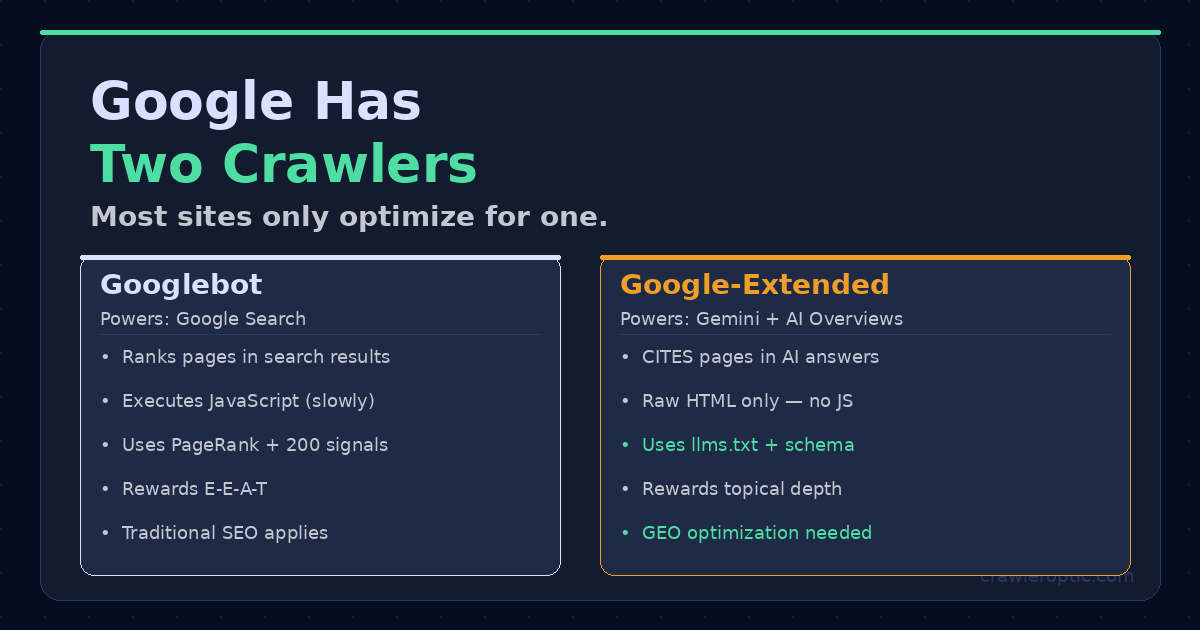 Google operates two separate crawlers. Googlebot ranks pages in Search. Google-Extended cites pages in Gemini and AI Overviews.
Google-Extended is a separate user agent that Google introduced in 2023 and expanded significantly in 2025-2026. Website owners can identify it in their server logs by this user agent string:
Googlebot-Extended/1.0
Unlike Googlebot, which crawls content for search ranking purposes, Google-Extended specifically crawls content to:
- Train and improve Gemini's language understanding
- Power real-time citations in Google AI Overviews
- Update the knowledge base that Gemini draws from when answering questions
- Identify authoritative sources for specific topics
The key difference: Googlebot ranks pages. Google-Extended cites them.
How Google-Extended Discovers Your Site
Google-Extended follows a discovery path similar to Googlebot but with different prioritization:
Discovery Phase
Google-Extended starts from your sitemap and known high-authority domains. It prioritizes sites that already rank well in Google Search — another reason traditional SEO and AI SEO are complementary rather than competing.
Crawl Phase
Like all AI crawlers, Google-Extended reads raw HTML. It does not execute JavaScript. Content rendered client-side by frameworks like React or Next.js (without SSR) may be partially or completely invisible.
Google-Extended pays particular attention to:
- Structured data (JSON-LD schema markup)
- E-E-A-T signals (author credentials, publication dates, organizational identity)
- Content freshness (recently updated pages get recrawled more frequently)
- Topical completeness (sites that cover a topic comprehensively)
Indexing Phase
Content that passes Google-Extended's quality filters enters a separate index from Google Search. This index is used specifically for Gemini responses and AI Overviews.
Google AI Overviews: The High-Stakes Placement
Google AI Overviews (formerly Search Generative Experience) appear at the very top of Google Search results for an increasing percentage of queries. They provide a synthesized answer and cite 3-5 sources with direct links.
Being cited in an AI Overview delivers:
- Massive visibility — appearing above all organic results
- High-trust signaling — users perceive AI Overview citations as authoritative
- Click-through traffic — cited sources receive significant referral traffic
Getting into AI Overviews requires satisfying Google-Extended's criteria, not just Googlebot's ranking algorithm.
What Google-Extended Prioritizes
Based on observed citation patterns in 2026, Google-Extended weights these signals heavily:
1. Author and Organizational Credibility (E-E-A-T)
Google-Extended strongly favors content with clear authorship, organizational identity, and expertise signals. This means:
- Author bio pages with credentials
- About pages that clearly describe your organization
- Contact information that establishes real-world existence
- Consistent brand identity across your site and third-party mentions
Add Person and Organization JSON-LD schema to reinforce these signals:
{
  "@context": "https://schema.org",
  "@type": "Organization",
  "name": "Your Company",
  "url": "https://www.yourdomain.com",
  "description": "What your company does",
  "foundingDate": "2024",
  "sameAs": [
    "https://twitter.com/yourhandle",
    "https://linkedin.com/company/yourcompany"
  ]
}
2. Content Freshness
Google-Extended recrawls pages more frequently than Googlebot. Publishing dates and dateModified schema matter significantly. Always include:
{
  "@type": "Article",
  "datePublished": "2026-03-27",
  "dateModified": "2026-03-27"
}
3. Structured Data Completeness
Pages with comprehensive schema markup are dramatically more likely to be cited in AI Overviews. At minimum, every page should have:
WebPageorArticleschemaBreadcrumbListfor navigation contextFAQPageschema for question-answer contentHowToschema for step-by-step guides
4. Direct, Factual Answers
AI Overviews synthesize answers from multiple sources. Content that provides clear, factual, directly answerable statements — without excessive hedging or promotional language — gets extracted more reliably.
5. llms.txt
While Google Search does not use llms.txt as a ranking signal, Google-Extended has been observed to access llms.txt files to understand site structure and content priorities. Generate yours at CrawlerOptic.
How to Control Google-Extended Access
You have full control over whether Google-Extended can access your content. This is important for sites with proprietary information, paywalled content, or concerns about AI training data.
To allow Google-Extended (recommended for most sites):
User-agent: Google-Extended
Allow: /
To block Google-Extended from specific sections:
User-agent: Google-Extended
Allow: /blog/
Disallow: /proprietary-research/
Disallow: /premium-content/
To block Google-Extended entirely:
User-agent: Google-Extended
Disallow: /
Note: Blocking Google-Extended does NOT affect your Google Search rankings. Googlebot operates independently.
The Three-Crawler Strategy for 2026
To maximize AI visibility across all major platforms, you need a strategy that addresses all three primary AI crawlers:
| Crawler | Platform | What it powers |
|---|---|---|
| Google-Extended | Gemini, AI Overviews | |
| GPTBot | OpenAI | ChatGPT answers, web search |
| ClaudeBot | Anthropic | Claude responses, citations |
Your robots.txt should explicitly allow all three:
User-agent: Google-Extended
Allow: /

User-agent: GPTBot
Allow: /

User-agent: ClaudeBot
Allow: /

User-agent: *
Allow: /
Disallow: /admin/
Disallow: /api/

Sitemap: https://www.yourdomain.com/sitemap.xml
Your llms.txt file provides a structured briefing to all three. Your schema markup gives all three machine-readable context. Your server-side rendered content ensures all three can read your actual words.
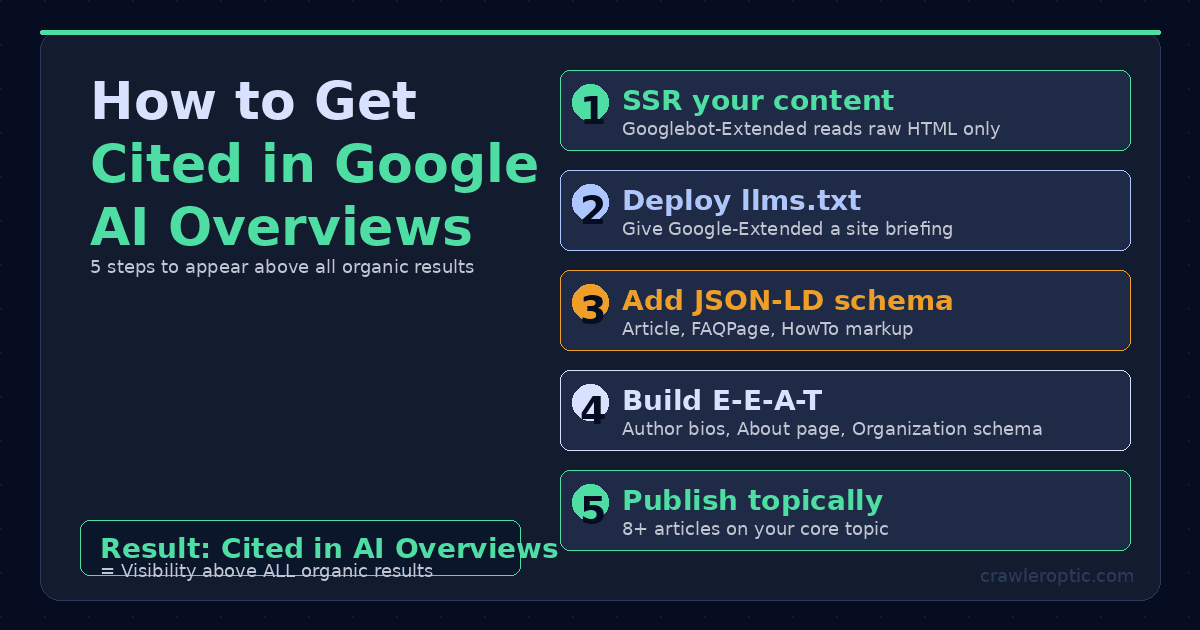
Practical Steps to Get Cited in Google AI Overviews
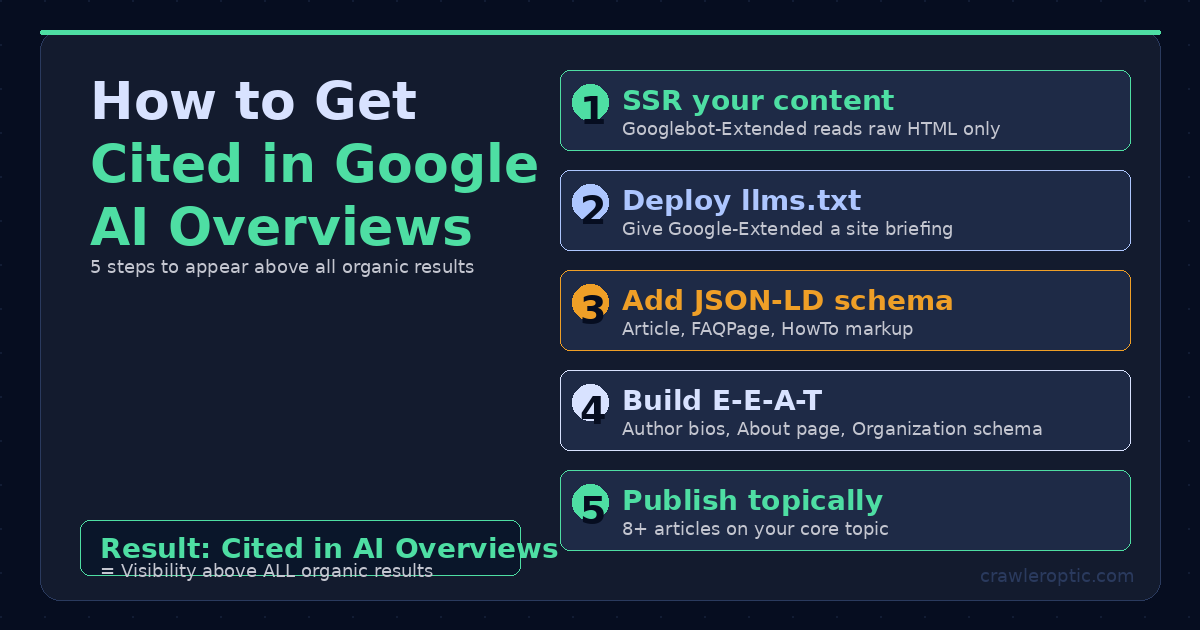 Five technical and content steps to earn citations in Google AI Overviews — the placement above all organic search results.
Based on analysis of sites consistently appearing in AI Overviews in 2026:
Step 1: Fix technical accessibility (today)
Verify Google-Extended isn't blocked. Check your SSR. Generate and deploy your llms.txt. Add comprehensive JSON-LD schema.
Step 2: Establish E-E-A-T signals (this week) Add author bios, update your About page, add Organization schema, link your social profiles. Google-Extended needs to understand who is behind your content.
Step 3: Create FAQ and HowTo content (this month)
These content formats are disproportionately cited in AI Overviews because they provide clear, extractable answers. Add FAQPage schema to any page with question-answer content.
Step 4: Build topical authority (ongoing) Publish consistently on your core topic. AI Overviews prefer sources that demonstrate sustained expertise, not one-off articles.
Step 5: Earn external mentions (ongoing) Get mentioned in industry publications, newsletters, and communities. Google-Extended weights external corroboration heavily.
Bottom Line
Google's Gemini and AI Overviews are becoming a primary discovery channel for millions of users. The crawler that powers them — Google-Extended — operates differently from Googlebot and rewards different optimizations.
The sites winning AI Overview citations in 2026 combine strong traditional SEO with AI-specific additions: SSR rendering, llms.txt files, comprehensive schema markup, and clear E-E-A-T signals.
Start with the free technical foundation at CrawlerOptic, then work through the E-E-A-T and content strategy steps above.
Optimize for Google-Extended today: generate your free llms.txt at CrawlerOptic.