Does ChatGPT Crawl Your Website? The Complete 2026 Guide
ChatGPT actively crawls millions of websites using GPTBot. Here's exactly how it works, what it reads, and how to make sure your site gets cited in AI answers.
Does ChatGPT Actually Crawl Your Website?
Yes — ChatGPT crawls your website right now, and it's doing it very differently from Google.
OpenAI operates a dedicated web crawler called GPTBot. This bot visits websites, reads their content, and uses that information in two ways: to update ChatGPT's training data over time, and to power real-time web search results when a user asks ChatGPT to "search the web."
If your website isn't optimized for GPTBot, you're invisible in one of the fastest-growing search channels of 2026. Over 45% of Americans now use AI tools weekly for research — and that number is accelerating.
Use the free llms.txt generator at CrawlerOptic to instantly create a file that helps GPTBot accurately understand and cite your website.
How GPTBot Works — Step by Step
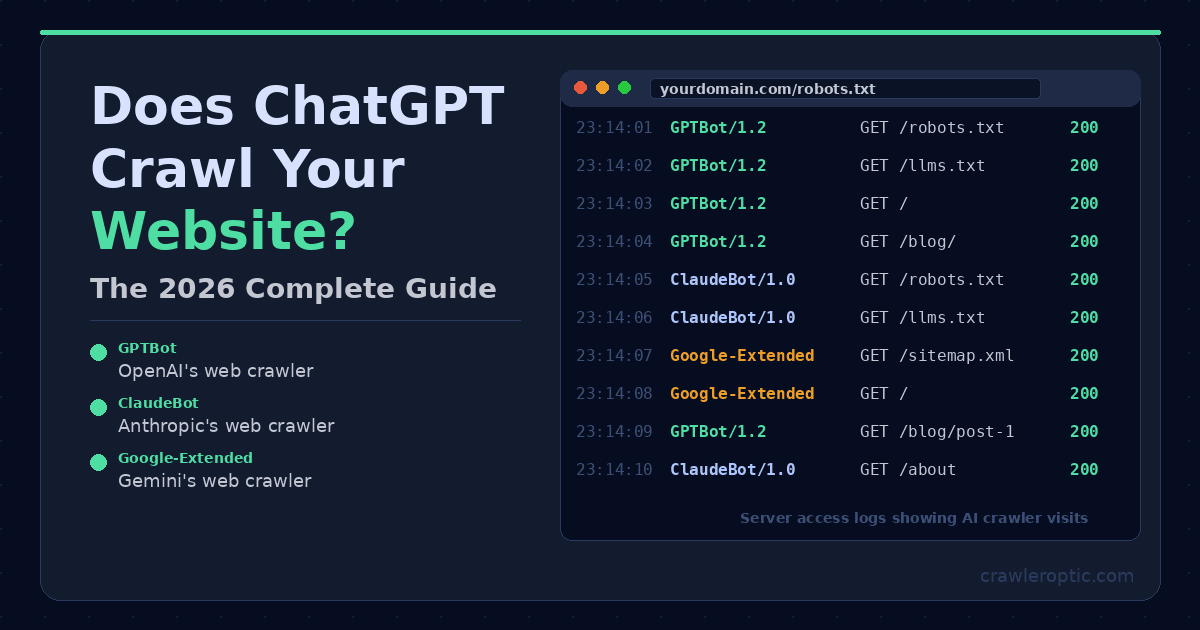
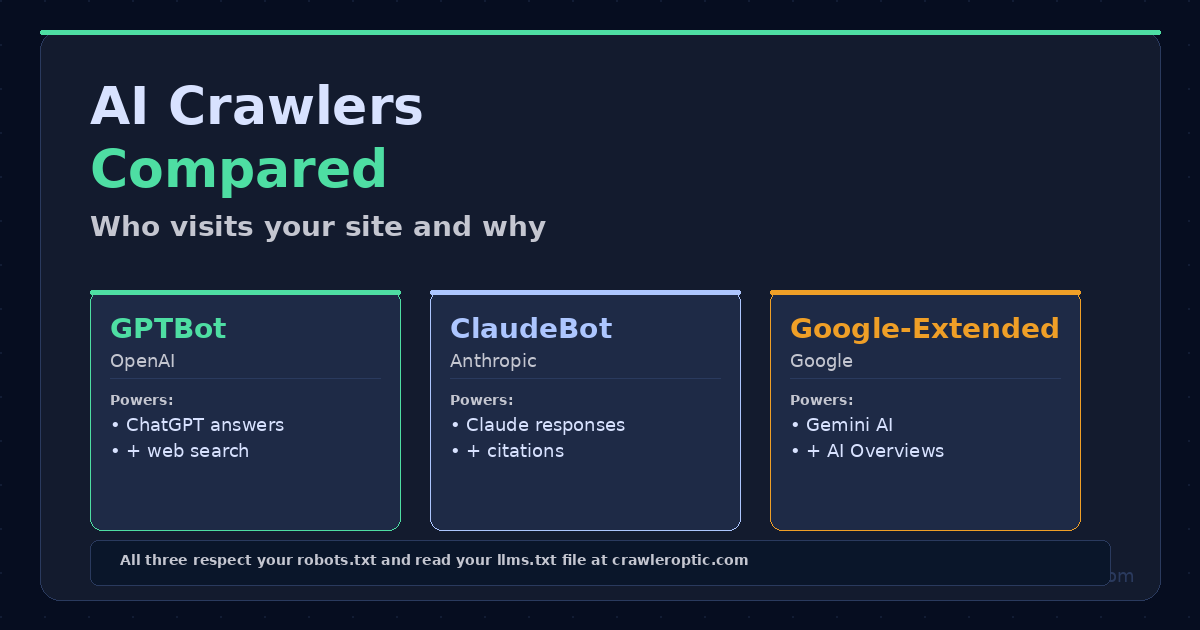 The three major AI crawlers — GPTBot, ClaudeBot, and Google-Extended — each power different AI platforms.
Understanding GPTBot's behavior is the first step to optimizing for it.
Step 1: Discovery
GPTBot discovers your site the same way Google does — through links from other sites, sitemaps, and direct URL lists maintained by OpenAI. The more backlinks your site has from reputable sources, the faster GPTBot finds you.
Step 2: Crawling
GPTBot sends an HTTP request to your pages. Critically, GPTBot reads raw HTML only. It does not execute JavaScript. If your content only appears after JavaScript runs — such as in a React or Next.js client-side component — GPTBot may not see it at all.
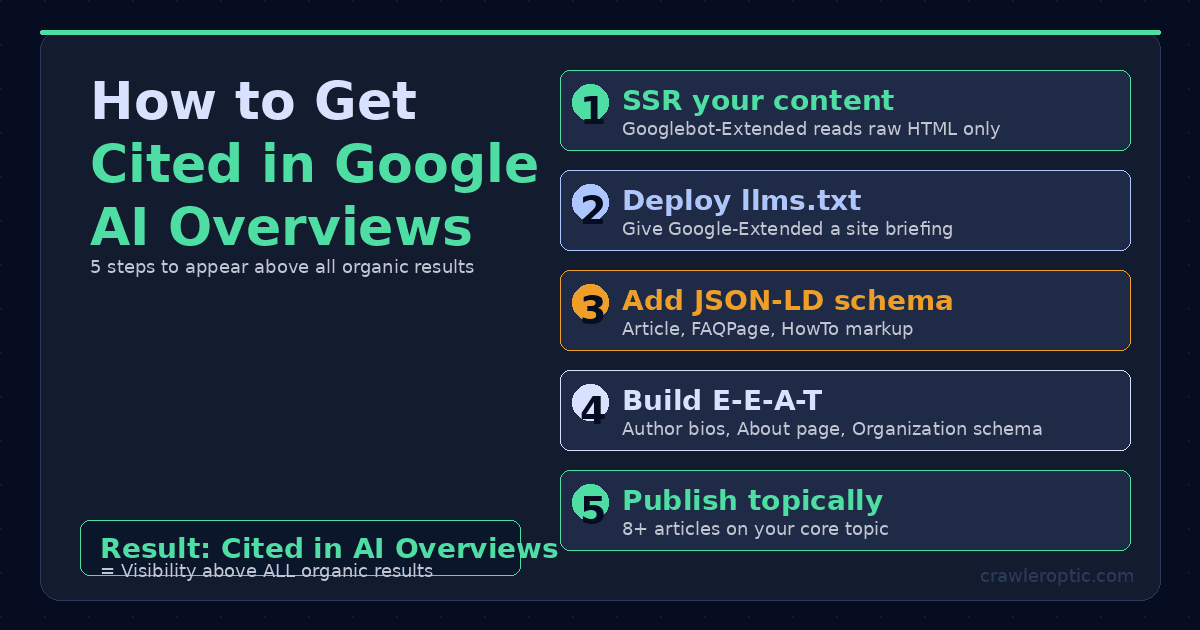
This is why server-side rendering (SSR) is essential for AI visibility in 2026.
Step 3: Content Extraction
GPTBot extracts your page title, headings (H1, H2, H3), body text, and metadata. It ignores navigation, ads, and boilerplate. A clean, well-structured page gives it significantly more to work with.
Step 4: Indexing and Citation
Extracted content goes into OpenAI's systems. When a user asks ChatGPT a relevant question, your content can be cited as a source — with a direct link back to your page.
How to Check if GPTBot is Visiting Your Site
Open your server logs or Vercel/Netlify analytics and search for this user agent string:
Mozilla/5.0 AppleWebKit/537.36 (KHTML, like Gecko; compatible; GPTBot/1.2; +https://openai.com/gptbot)
If you see it, GPTBot is already crawling you. If you don't, your site may be blocking it — or it simply hasn't discovered your domain yet.
Is Your Site Blocking GPTBot?
Many websites accidentally block GPTBot without realizing it. The most common causes are:
robots.txt blocking all bots. Check your robots.txt file. If it contains Disallow: / under User-agent: * without a specific Allow rule for GPTBot, you're blocking it.
Cloudflare AI bot blocking. Cloudflare's default settings in 2026 block many AI crawlers. If you use Cloudflare, go to Security → Bots and make sure GPTBot is not blocked.
JavaScript-only rendering. If your entire page renders client-side, GPTBot sees an empty shell. Switch to SSR or add static HTML for your key content.
To explicitly allow GPTBot, add this to your robots.txt:
User-agent: GPTBot
Allow: /
The Three AI Crawlers You Need to Know
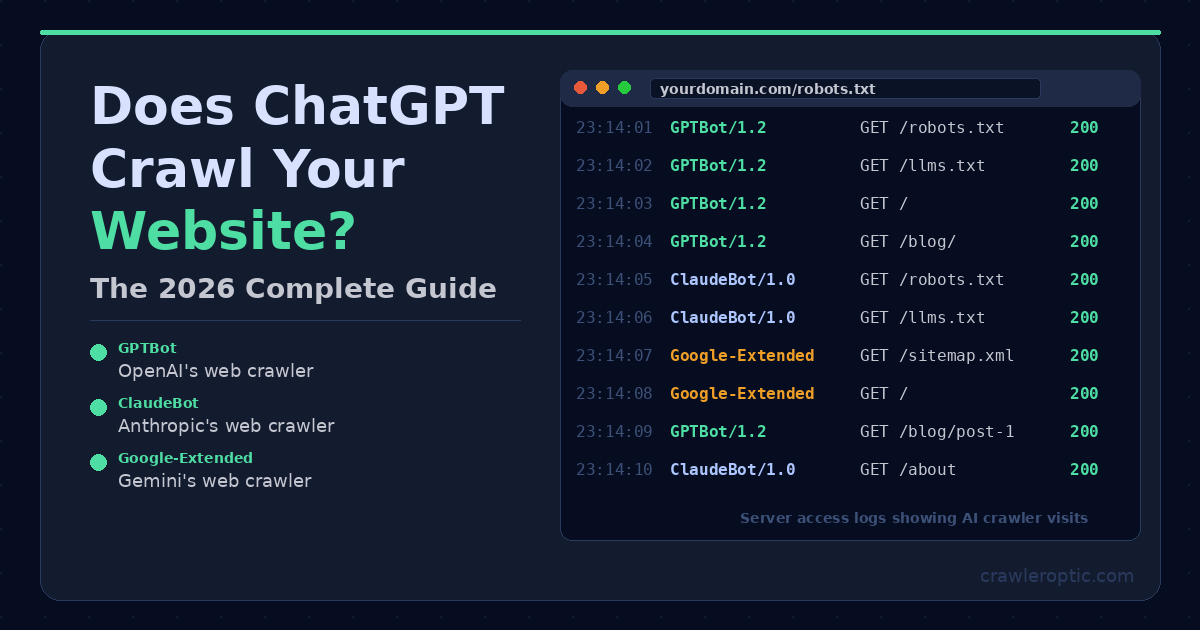 Server logs showing GPTBot, ClaudeBot, and Google-Extended visiting a site. Check yours at your hosting dashboard.
GPTBot is just one of three major AI crawlers visiting websites in 2026:
| Crawler | Company | Used For |
|---|---|---|
| GPTBot | OpenAI | ChatGPT training + web search |
| ClaudeBot | Anthropic | Claude AI training + citations |
| Google-Extended | Gemini AI training |
Each crawler has different behavior and priorities. Optimizing for all three is the new baseline for serious content publishers.
How to Optimize Your Site for ChatGPT Citations
Getting cited by ChatGPT requires more than just being crawlable. Here's what actually works:
1. Use Server-Side Rendering
Your most important content — especially headings, introductions, and key facts — must be in the raw HTML that the server returns. JavaScript-rendered content is invisible to AI crawlers.
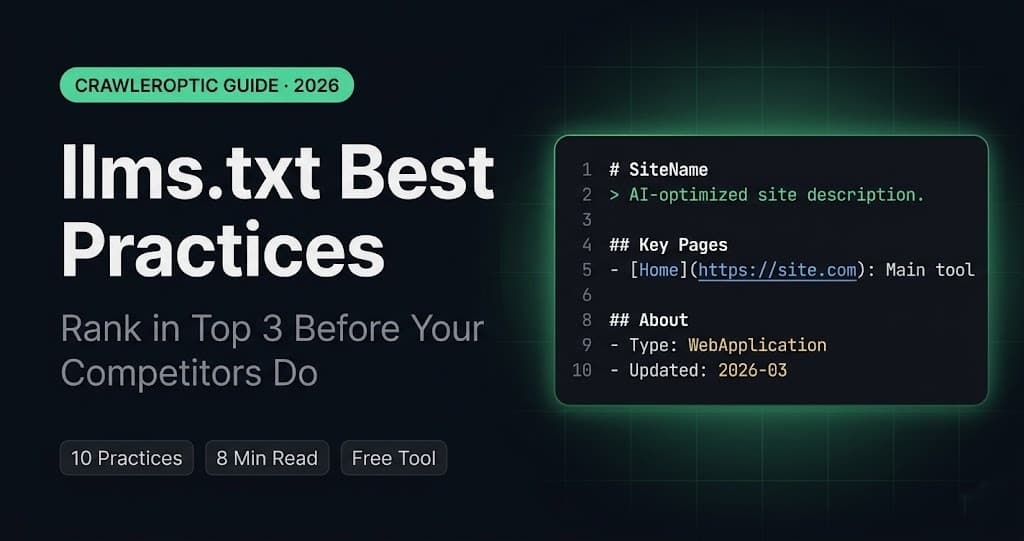
2. Create a llms.txt File
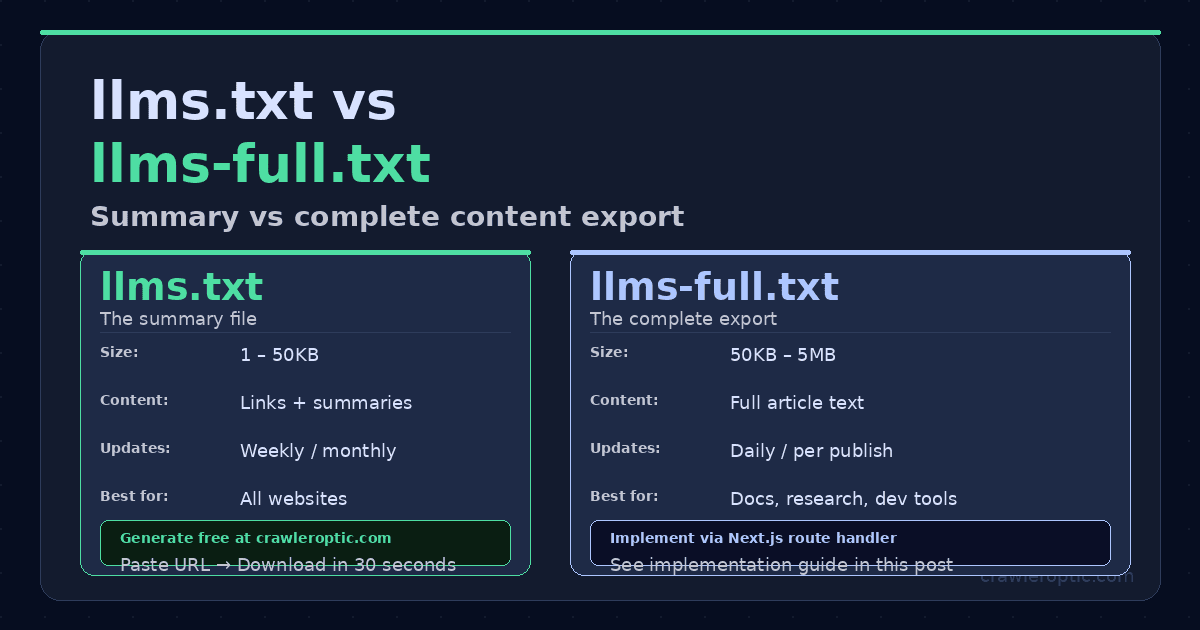
The llms.txt standard is an emerging protocol that gives AI crawlers a structured, clean summary of your site. Place it at yourdomain.com/llms.txt and it acts as a direct briefing for GPTBot, ClaudeBot, and others about who you are, what you publish, and which pages matter most.
Generate yours for free in seconds at CrawlerOptic — just enter your URL and download the file.
3. Structure Your Content for Direct Answers
ChatGPT prefers content that directly answers questions. Use H2 headings phrased as questions ("How does X work?"), followed by a clear, concise answer in the first paragraph under that heading. This format dramatically increases your chances of being cited.
4. Add Schema Markup
JSON-LD structured data tells AI systems exactly what type of content you're publishing. At minimum, add Article or SoftwareApplication schema to your pages. This gives AI crawlers verified, machine-readable context.
5. Build Topical Authority
ChatGPT doesn't cite random pages — it cites sources that demonstrate consistent expertise on a topic. Publishing 8-10 high-quality articles in your niche signals topical authority to both AI systems and traditional search engines.
What ChatGPT Will and Won't Cite
Understanding ChatGPT's citation behavior helps you create content that gets referenced.
ChatGPT tends to cite content that:
- Directly and completely answers the user's question
- Comes from a domain with multiple articles on the same topic
- Is written in clear, factual language with verifiable claims
- Has been live for at least a few weeks (recency matters for live search)
- Has backlinks from other reputable sites
ChatGPT tends to avoid citing content that:
- Is thin, vague, or promotional in tone
- Contradicts well-established facts without strong sourcing
- Comes from a brand-new domain with no external mentions
- Is hidden behind JavaScript rendering
- Has no structured data or semantic markup
The Bottom Line
ChatGPT is actively crawling and citing websites right now. If your site isn't technically accessible to GPTBot, properly structured for AI comprehension, and supported by an llms.txt file, you're missing one of the biggest traffic opportunities of 2026.
The good news: optimizing for AI crawlers is straightforward once you know what they're looking for. Start with the free llms.txt generator at CrawlerOptic, verify your robots.txt isn't blocking GPTBot, and make sure your key content is server-side rendered.
The websites that adapt now will compound their AI visibility advantage for years.
Generate your llms.txt file free at CrawlerOptic — no account required, results in seconds.